
Is L-Hyaluronic Acid the Key to Superior Hydration?
The Science Behind L-Hyaluronic Acid: More Than Just a "Moisture Magnet"
First, let’s clarify the basics. Hyaluronic Acid (HA) is a naturally occurring polysaccharide composed of repeating disaccharide units of D-glucuronic acid and N-acetylglucosamine, linked by alternating β-1,3 and β-1,4 glycosidic bonds. Discovered in 1934 by Columbia University ophthalmologist Meyer and Palmer from bovine eye vitreous humor, it’s earned the nickname "natural moisture magnet" for its ability to absorb up to 1,000 times its weight in water. But HA’s properties vary drastically with its molecular weight, measured in Daltons (Da)—a key factor that divides it into distinct functional categories.
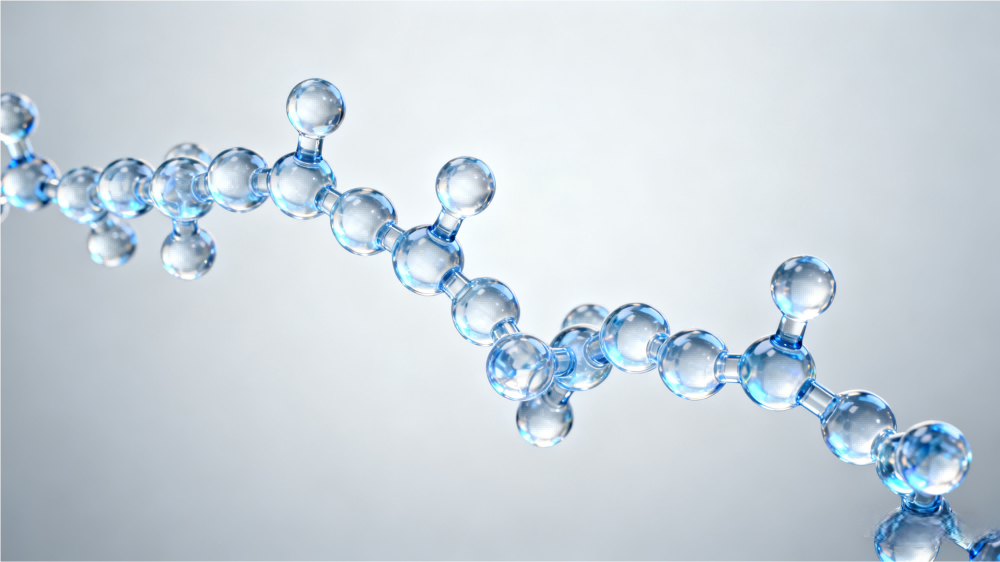
L-Hyaluronic Acid typically ranges from 10,000 to 500,000 Da, setting it apart from medium molecular weight HA (500,000–1,000,000 Da) and high molecular weight HA (H-HA, above 1,000,000 Da) . This small molecular size is its greatest advantage: while H-HA molecules are too large to penetrate the stratum corneum, remaining on the skin’s surface to form a protective barrier against moisture loss, L-HA’s tiny structure allows it to permeate deep into the dermis layer. This penetration isn’t just surface-level hydration—it reaches the skin’s "moisture reservoir" where collagen and elastin fibers reside, delivering long-lasting hydration rather than temporary relief.
The biological mechanism of L-HA is well-documented. A 2025 study published in Journal of Cosmetic Dermatology tested a hybrid formula of H-HA (1.2 million Da) and L-HA (150,000 Da) on 80 participants with dry, Aging Skin. Using corneometry to measure skin hydration and confocal microscopy to observe dermal changes, researchers found that L-HA increased skin hydration by 40% after 4 weeks and 58% after 8 weeks, while also stimulating fibroblast activity—the cells responsible for collagen synthesis—in the dermis . The study’s lead author, Yazdanparast T, noted that "low molecular weight hyaluronic acid doesn’t just ‘add’ moisture, it activates the skin’s natural hydration-regulating system, leading to sustained improvement even after temporary product discontinuation" .
Another critical function of L-HA is skin barrier repair. The stratum corneum’s barrier function relies on a "brick-and-mortar" structure of keratinocytes (bricks) and intercellular lipids (mortar). Factors like UV radiation, harsh cleansers, and aging disrupt this structure, causing transepidermal water loss (TEWL). Research demonstrates that L-HA penetrates to the granular layer of the epidermis, where it upregulates the expression of filaggrin and ceramides—key components of the lipid barrier. After 7 days of treatment, TEWL in the test group decreased by 32%, compared to only 8% in the H-HA group. This makes L-HA ideal for sensitive or barrier-damaged skin, as it addresses dryness at the source rather than masking symptoms.
Beyond Cosmetics: L-HA’s Multi-Field Applications
- Medical Aesthetics: The "Core Ingredient" in Professional Treatments
M-HA is a staple in injectable aesthetic treatments like mesotherapy. These injectable formulations typically use ultra-low molecular weight L-HA (below 100,000 Da) for optimal dermal diffusion, allowing it to spread evenly in the dermis after injection and form a continuous moisture network that improves skin dryness, fine lines, and dullness.
- Oral Beauty: From Inside-Out Hydration
Recent research has validated the efficacy of oral L-HA supplements. A 2024 randomized, double-blind, placebo-controlled trial published on PubMed enrolled 129 female participants aged 20–65, who took 120mg of L-HA (200,000 Da) or a placebo daily for 12 weeks. Results showed that oral L-HA significantly improved skin hydration in both young (20–35) and elderly (50–65) groups after 2–8 weeks. After 12 weeks, epidermal thickness increased by 18% in the elderly group, and skin elasticity improved by 23% in the young group .
- Medical Field: Wound Healing and Ophthalmology
In medicine, L-HA’s ability to promote tissue repair and reduce inflammation makes it valuable for wound care. Studies have found that L-HA hydrogels accelerate the healing of second-degree burns by 40% compared to standard dressings, as it maintains a moist wound environment and stimulates angiogenesis (new blood vessel formation). In ophthalmology, L-HA eye drops are used to treat dry eye syndrome—its small molecules penetrate the ocular surface epithelium, relieving irritation and improving tear film stability without blurring vision.
Cosmetic Applications: How L-HA Works in Everyday Products
- Serums
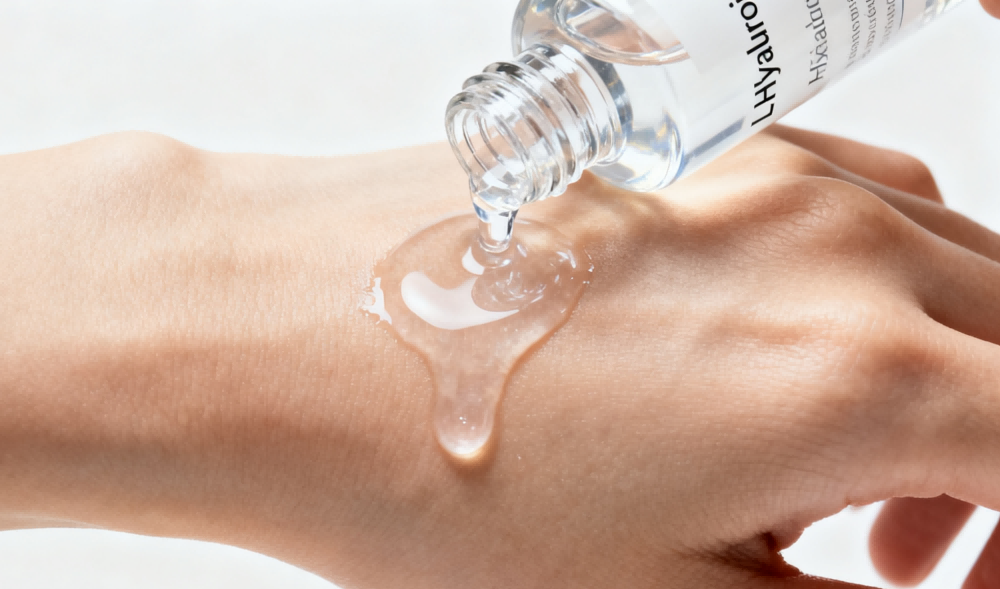
Concentrated L-HA serums (typically 0.5–2% concentration) are the most popular format. Their lightweight, aqueous texture allows rapid penetration—studies show that L-HA serums reach the upper dermis within 5 minutes of application. Brands often pair L-HA with sodium hyaluronate (a salt form of HA with even smaller molecules) and glycerin to create a "moisture gradient" that draws water from the environment and locks it in .
- Moisturizers
Day and night creams commonly combine L-HA with H-HA for a "double-layer hydration system." H-HA forms a surface barrier to prevent moisture evaporation, while L-HA delivers deep hydration. For dry skin, formulations may add shea butter or squalane to enhance occlusion. For oily skin, oil-free L-HA moisturizers use lightweight emulsifiers to avoid greasiness.
- Face Masks
Sheet masks and gel masks use L-HA’s high water-holding capacity to deliver an "intensive hydration boost."
- Sunscreens
Innovative sunscreen formulations now include L-HA to counteract the drying effects of UV filters. A 2023 study in Photodermatology, Photoimmunology & Photomedicine showed that sunscreens with 1% L-HA reduced TEWL by 25% compared to standard sunscreens, while maintaining SPF efficacy. This addresses a common complaint: that sunscreens leave skin tight or flaky.
Comparing L-Hyaluronic Acid to Other Hydrating Ingredients
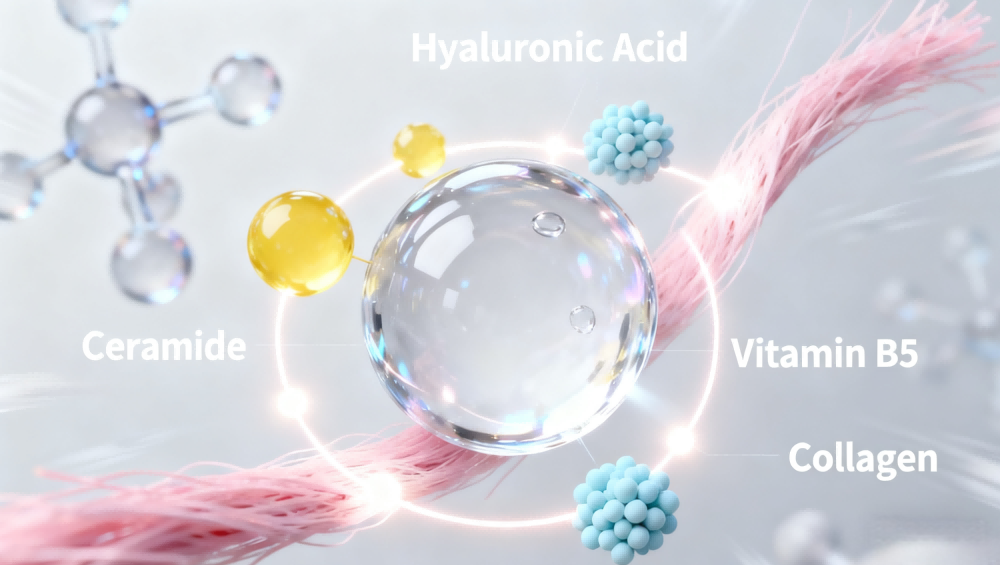
High-molecular-weight HA primarily forms a surface barrier, offering instant moisture and protection from environmental stress but no deep penetration, resulting in temporary effects. Glycerin attracts water through osmosis, is low-cost, and works in low humidity, but can cause dryness if humidity drops below 40%. Collagen forms a film on the skin and supports structure to improve elasticity, but its large molecules mean minimal penetration. Ceramides repair the lipid barrier, reducing TEWL and suiting sensitive skin, but deliver slow results that require consistent use.
In contrast, L-Hyaluronic Acid penetrates deeply into the dermis and stimulates the skin’s natural hydration system, providing long-lasting moisture while repairing the barrier and offering anti-aging benefits. Its only notable limitation is that it requires water to work effectively, so it’s best applied to damp skin. This combination of deep action, multi-functional benefits, and compatibility with various skin types sets L-HA apart as a superior hydrating ingredient.
Conclusion: L-HA as a Hydration Staple
So, is L-Hyaluronic Acid the key to superior hydration? The science, clinical data, and real-world applications make a compelling case. Its ability to penetrate deeply, activate the skin’s natural moisture systems, repair barriers, and work across cosmetics, medical aesthetics, and oral supplements sets it apart from traditional hydrating ingredients. Whether you’re dealing with dryness, early signs of aging, sensitive skin, or seeking to maintain results from professional treatments, L-HA offers a science-backed solution.
- Name: Yuki
- E-mail: sales02@nahanutri.com
- WhatsApp:+8618066950297